

Export of Manpower From Pakistan - Empowering Dreams: Pakistan's Dynamic Workforce Ventures Abroad for Global Opportunities.
Pakistan's Manpower Export Potential to The world
Pakistan in is the fifth-most populous country, with a population of over 241.5 million. It is one of the largest labor markets in the world. Around 65% of Pakistan’s population is quite young and the government should equip this talent with the latest skills and training to improve their prospects. Pakistan has surplus manpower and with prevailing unemployment, people are quite anxious to get employment in the country or abroad. Thus Pakistan has a great potential for Export of Manpower From Pakistan of the surplus labor force.
Pakistan has a massive workforce of over 79 million, making it the world’s sixth largest. Every year, many people travel to the Middle East, Europe, Japan, South Korea, the United States, and Canada, driven by expanding populations, poverty, a lack of job prospects, and a desire for a better future. Export of Manpower from Pakistan has historically been inconsistent and low since reaching their peak in 2015, when 946,571 emigrants, largely skilled, semi-skilled, and unskilled workers, departed the country to earn a living. Since then, the number of emigrants has steadily decreased, ranging from 496,286 (2017) to 288,280 (2021), with a low of 225,213 in 2020.
In 2022 alone, 17,976 highly qualified and 20,865 highly talented Pakistanis departed their country for better prospects overseas.
Govt. of Pakistan Exporting Manpower targets for Export of Manpower From Pakistan
The Federal Ministry for Overseas Pakistanis and Human Resource Development (OP & HRD) is striving to grant a quota to Overseas Employment Promoters (OEPs)/International Recruitment Agencies in Pakistan in order to increase Export of Manpower From Pakistan , with a goal of one million exports this year.
Against a target of one million workers per year, Pakistan’s manpower exports totaled 372,000 between July 2022 and May 2023 (11 months), one of the lowest-ever numbers of emigrants. Estimates for offering work abroad to Pakistanis in June are around 13,000. In comparison, Bangladesh has granted a seven-year high abroad employment to 1,144,993 of its workers in the fiscal year ending June 30, 2023. If we compare Export of Manpower from Pakistan compared to Bangladesh, it lower and Bangladesh has been doing quite well.
Number of Overseas Employment Promoters in Pakistan /International Recruitment Agencies in Pakistan helping to boost Export of Manpower from Pakistan.
Over 4700 OEPs work in Pakistan, with approximately 2200 of them being active. Overseas Employment Promoters should play a role in boosting manpower exports, and the government should encourage them in this regard by involving OEPs in delegations abroad so they can explore new opportunities for manpower export from Pakistan.
New Manpower Export Markets for Pakistan to Enhance Export of Manpower from Pakistan.
Pakistan is expanding to get into new markets and in this OEPs have visited several countries, including Romania, Portugal, and Greece, which have expressed an interest in importing labor from Pakistan. There are many new countries like:
- Poland,
- Malaysia,
- Malta,
- Hungary,
- South Korea,
- Japan,
- Tajikistan,
- Saudi Arabia,
- Iran and
- Iraq
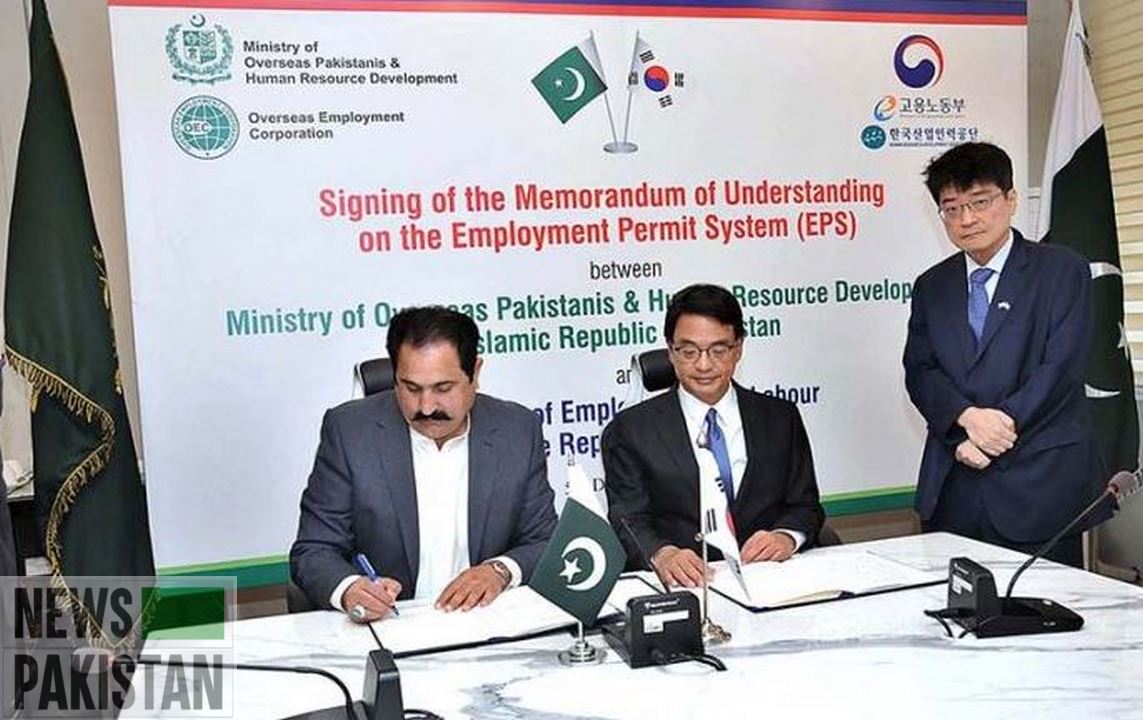
All have also shown an interest in importing Pakistani manpower and many of them have also signed MoUs.
European countries, Japan, and Korea, aside from the Gulf countries, are looking for IT expertise in addition to doctors and engineers from Pakistan. This will further increase Export of Manpower from Pakistan
How to increase manpower Supply from Pakistan? Export of Manpower from Pakistan?
Export of Manpower from Pakistan can be increased by participation in the International Human Resources & Labor Services Expos being hosted in Riyadh and other countries, this is recommended for the Ministry of Overseas Pakistanis and Human Resource Development (OP&HRD), Overseas Employment Promoters (OEP), and Foreign Recruitment Companies in Pakistan.
Showcasing Pakistan’s workforce on the global stage through Pakistani Embassies. Exhibit the capabilities and potential of its labor force demonstrating the rich potential of Pakistan’s technical workforce.
Understand needs of the international job market and tailor our skills, trainings to meet the evolving demands of the global job market
Establish new vocational training centers across Pakistan, specifically tailored to meet the job market demands of regions like Saudi Arabia and the EU region. There need to be Pakistan’s strong commitment to developing a skilled workforce ready to meet global challenges.
Open new protector offices in Islamabad, Sukkur, Abbottabad, Bannu, Gilgit Baltistan to facilitate OEPs and spread awareness in respective areas so that youth may get skilled training and find well-paying opportunities abroad. By adopting above recommendations, Export of Manpower from Pakistan can be significantly enhanced.
The export of manpower from Pakistan to Boost Foreign exchange reserves
Promoting the Export of Manpower from Pakistan is the best way to increase remittances and improve our forex reserves as Pakistan grapples with the low level of foreign exchange reserves,
Remittances of the overseas Pakistanis are the backbone of the national economy, which are now more than total exports of goods and services exported annually thereby contributing largely to Pakistan’s foreign reserves.
Remittances during July 2022 to June 2023 (12 months) declined to $27.024 billion, having registered about 14% decrease compared to the last year’s remittances totaling $31.278 billion, which at that time was the highest inflow of remittances since 2013.
If there is declining trend of export of human resources that will reflect on abysmal performance of the Ministry of Overseas Pakistanis & Human Resource Development and organizations under its administrative control like BEOE and OEC.
The BEOE is mainly responsible for processing recruitment demands for different job markets through Overseas employment promoters, whereas the Overseas Employment Corporation (OEC) is the public sector recruitment agency. Both are government entities responsible to increases Export of Manpower from Pakistan
The inflow of foreign remittances from overseas Pakistanis is not proportional to the number of emigrants who have gone to work abroad. The average annual remittance by an overseas Pakistani is three to four times that of a Bangladeshi residing abroad. Obviously, remittances to Pakistan include money transferred by illegal immigrants working all over the world, including Israel, as recently reported in the press.
Several years ago, it was revealed on the National Assembly floor that approximately 75,000 emigrants travel illegally to other nations each year. The recent boat disaster, in which at least 300 Pakistanis killed off the coast of Greece, has emphasized the seriousness of people trafficking in Pakistan.
The situation has also brought to light Pakistan’s immigration issues in light of the weak legal, regulatory, and enforcement framework pertaining to migration; hence, the Ministry of Overseas Pakistanis & Human Resource Development, as well as its related departments, cannot be exempted from accountability.
The United Arab Emirates, the United nations, Saudi Arabia, the Gulf nations (Bahrain, Kuwait, Qatar, and Oman), Australia, Canada, Japan, the United Kingdom, Norway, and Switzerland are the main sources of remittances to Pakistan.
Why Pakistan Manpower Supply Decreased?
The overall Pakistani export of manpower suffered a huge blow During the COVID-19 period. Not only the manpower export declined to the lowest level in decade but also the international companies disengaged their Pakistan workers who were already employed in various countries. It was a two-way impact on manpower export decline.
Main Manpower Supply Markets for Pakistan to Enhance Export of Manpower from Pakistan
Faced with an economic disaster that has resulted in rising inflation and a balance of payments problem, Pakistan exported 0.83 million human resources in 2022, primarily to Saudi Arabia and the United Arab Emirates (UAE).
According to government data, the Gulf market has traditionally absorbed roughly 77% of Pakistan’s skilled labor pool, with the South Asian country exporting over 12.7 million workers to approximately 50 countries since 1971.
Pakistani migrants are looking for work in Gulf countries, with “almost 80% to 85%” heading to Saudi Arabia, the UAE, and other Gulf region countries.
There appears to be a large demand for professional and unskilled workers from many nations, despite the fact that we have lost traditional Middle Eastern markets, where Pakistan reigned for decades, to our competitors—primarily Bangladeshis and Chinese.
On the other hand, the BEOE is struggling to meet demand, owing to a lack of a policy framework for human resource exports and inherent inefficiency. There are 116,826 jobs still vacant with the Bureau, including a backlog dating back to 2021, while the BEOE received a demand for approximately 13,000 jobs in July of this year from Saudi Arabia, the UAE, Iraq, Oman, Qatar, Bahrain, Kuwait, South Korea, Malaysia, and other nations.
The long list contains a wide range of construction and agricultural professions, including driver, mason, carpenter, plumber, electrician, mechanic, technician, barber, cook, and domestic worker. Civil engineers, mechanical engineers, electrical engineers, computer engineers, HVAC engineers, physicians, dentists, nurses, and managers are among the professionals needed, all these trades if managed properly can help increase “Export of Manpower from Pakistan”.
Which type of People are going abroad for bight future? Occupation of Immigrants from Pakistan:
“Doctors, engineers, skilled, semi-skilled [laborers], all types of people are going abroad for a better future, In 2022, approximately 2,300 to 2,400 doctors and nearly 5,500 engineers traveled abroad for jobs.
The diversity of professional occupations among the exiting workforce is impressive. A sizable majority choose labor-intensive jobs, with 192,188 people traveling abroad as laborers under the labor category visa
The positions like Drivers (96,466), technicians (12,491), salespeople (14,599), and electricians (9,847) all make up significant numbers for Export of Manpower from Pakistan.
Meanwhile, 5,811 agriculturalists, 7,031 carpenters, and 4,998 cooks sought work abroad.
Engineers, surgeons, IT specialists, and accountants are among the educated professionals who are migrating at a rapid rate. In the first half of 2023, 23,623 managers, 4,705 engineers, and 1,925 doctors contributed their skills and expertise to international markets.
Pakistani Nationals Migration trends:
Last year, in 2023, a total of 862,625 Pakistanis left the country of 241 million for jobs abroad, the biggest emigration rate since 2016, when 839,353 moved overseas. The year 2015 marked the highest amount of migration, with 946,571 Pakistanis leaving in pursuit of opportunities overseas. Between 2018 and 2021, this tendency had a significant drop.
The official emigration estimates may underestimate the trend since they omit persons seeking education overseas or using alternative immigration avenues. A Pakistani student in his late twenties who moved to Canada six months ago said he worked two jobs in Pakistan but couldn’t support his family. “This unprecedented inflation is wreaking havoc on the middle class. We are experiencing ongoing financial volatility as our purchasing power and affordability decline on a daily basis.”
As the tendency of Pakistani workers seeking better pastures abroad continues to expand, experts have expressed concerns about its influence on the nation’s workforce and economy. The government has been asked to develop local employment opportunities and policies that attract skilled expats to return and contribute to the country’s development.
Why Pakistanis are leaving Pakistan to Seek Employment in other countries?
The outflow of skilled professionals from Pakistan, known as “brain drain,” is primarily caused by an economic downturn, high inflation, a lack of industrial activity, and unprecedented political instability in Pakistan, in addition to the usual reasons of unemployment and socioeconomic issues in Pakistan, and a desire for greener pastures abroad.
People are fleeing Pakistan because they are not getting excellent jobs. Our industry lacks development, causing professionals to seek better training possibilities and higher incomes abroad. However, relying solely on remittances is not sustainable. In the first half of 2023, more than 450,000 Pakistanis departed the country in quest of better work possibilities abroad. Till the end of 2023, total 862,625 Pakistanis left Pakistan to seek jobs in other countries in 2023
The salaried class works hard, but the gap between what we earn and what it takes to live a decent life continues to widen. An increasing number of educated Pakistanis are looking for possibilities abroad to escape the country’s continuous and never ending economic cresses and problems.
Benefits of Manpower Export from Pakistan
International companies recruiting Pakistani specialists was a positive development because it increased remittances to the country. “Normally, doctors in Pakistan draw Rs80,000 to Rs90,000 salary ($278-319), and if they go abroad, they can get Rs600,000 ($2,092) to Rs700,000 ($2,441).
Over the last decade, Pakistan’s reliance on remittances has grown in comparison to exports. Export of Manpower From Pakistan not only benefits the country but also benefits the workers and their families in terms of higher salaries which otherwise can not be earned in Pakistan. This increases living standard and savings for future. At this juncture, Export of Manpower from Pakistan is beneficial by all means to earn the foreign exchange.
Drawback of Manpower Export from Pakistan:
While there are benefits to Export of manpower from Pakistan, there are also drawbacks and challenges associated with this practice. Some of the notable drawbacks include:
Brain Drain: One of the significant drawbacks is the loss of skilled and talented individuals from the country. When highly educated and skilled workers migrate to other countries for better opportunities, it can lead to a brain drain in Pakistan. This can hinder the country’s development and progress as it loses valuable human capital.
Dependency on Remittances: Pakistan heavily relies on remittances sent back by its overseas workforce. While these remittances contribute to the economy, the country becomes vulnerable to economic downturns in the destination countries. Changes in economic conditions or policies in the host countries can impact the income and job security of Pakistani workers abroad.
Exploitation and Vulnerability: Some migrant workers face exploitation and abuse in the host countries. Issues such as low wages, poor working conditions, and lack of legal protections can affect the well-being of Pakistani workers. They may be vulnerable to exploitation due to language barriers, unfamiliarity with local laws, and a lack of support systems.
Social Impact: Manpower export can have social consequences, particularly on families left behind. The separation of families can lead to emotional stress and disrupt social structures. Children may grow up without one or both parents, and this can have long-term impacts on family dynamics and relationships.
Skills Gap: The emigration of skilled workers can contribute to a skills gap in key sectors of the economy. This gap may hinder the country’s ability to innovate and compete globally. The loss of skilled professionals can also impact sectors such as healthcare, education, and technology.
Dependency on Specific Sectors: The export of manpower is often concentrated in specific sectors such as construction, healthcare, and IT. This concentration can make the country’s economy vulnerable to changes in the demand for labor in these sectors, leading to potential job shortages and economic instability.
Political and Security Risks: Political instability or security concerns in destination countries can pose risks to the safety and well-being of Pakistani workers abroad. Events such as wars, conflicts, or changes in government policies can disrupt the employment and residency status of expatriate workers.
Addressing these drawbacks requires a comprehensive approach, including the development of domestic employment opportunities, improvements in education and skill development, and policies to safeguard the rights and well-being of overseas Pakistani workers.
Where are Pakistani workers headed to for Foreign Jobs?
Saudi Arabia emerged as the primary destination for Pakistani migrant workers, with 205,515 choosing the kingdom as their new workplace.
The UAE followed closely with 121,745 relocating to the country, also known as ‘second home’ for many Pakistanis. Other Gulf countries, including Oman (34,140), Qatar (35,637) and Bahrain (7,441) also witnessed a significant influx of Pakistani workforce.
Beyond the Gulf region, a total of 16,166 opted for Malaysia, while China recorded 990 arrivals from Pakistan. Smaller number of Pakistani workers also headed to South Korea, Japan, Cyprus, Germany, the United Kingdom, Greece, Italy, and Romania.
Pakistani workers seek foreign employment opportunities in various countries around the world. The choice of destination often depends on factors such as economic conditions, demand for labor, language proficiency, and government policies. As of my last knowledge update in January 2022, some of the popular destinations for Pakistani workers include:
Middle East:
- Saudi Arabia
- United Arab Emirates (UAE)
- Qatar
- Oman
- Kuwait
- Bahrain
East Asia:
- Malaysia
- South Korea
Europe:
- United Kingdom
- Italy
- Spain
North America:
United States (especially in fields like IT and healthcare)
Other Countries:
- Canada
- Australia
These destinations attract Pakistani workers for various job opportunities, including construction, healthcare, information technology, hospitality, and domestic work. The Middle East has historically been a major destination due to the demand for labor in sectors like construction and services. Additionally, countries like Malaysia and South Korea have been popular for employment in industries such as manufacturing.
It’s essential to note that trends in labor migration can change over time based on economic conditions, political developments, and changes in immigration policies in both Pakistan and the destination countries. Additionally, new destinations may emerge as the global economic landscape evolves. For the most up-to-date information, it’s recommended to refer to recent reports from relevant government agencies and international organizations.
TOP 10 DESTINATIONS FOR PAKISTANI WORKFORCE IN 2023
| Top 10 Manpower Export Destinations of Pakistan | ||
| Sn. | Country | 2023 Manpower Export |
| 1 | Saudi Arabia | 426951 |
| 2 | U.A.E | 229894 |
| 3 | Oman | 60046 |
| 4 | Qatar | 55112 |
| 5 | Malaysia | 20905 |
| 6 | U.K | 16449 |
| 7 | Bahrain | 13345 |
| 8 | Romania | 4947 |
| 9 | Iraq | 4307 |
| 10 | Greece | 2914 |